60 Turns Later
On A.R. Ammons's great experiment in poetry and the agony of creating art

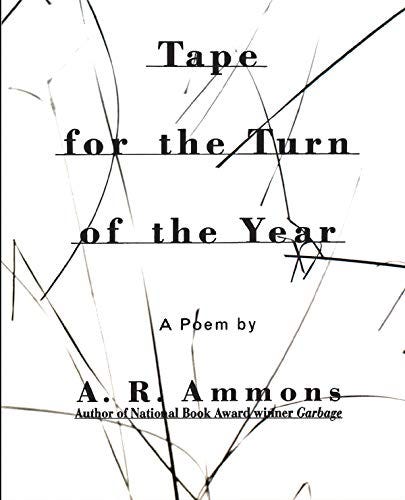
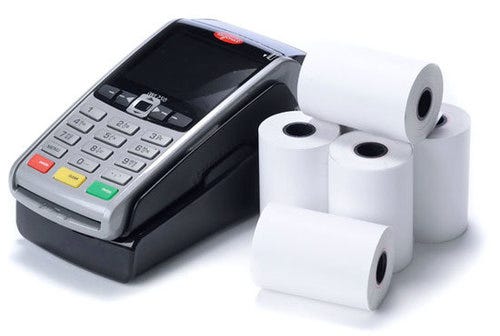
60 years ago today A.R Ammons reached the end of his epic poem “Tape for the Turn of the Year”, written on a large scroll of machine paper. 60 years and 34 days ago on December 6th, 1963, Ammons unspooled the fat, squat cylinder almost exclusively used by accountants and cashiers and fed it to his typewriter. Kerouac did something similar with his travelogue On The Road, but where Kerouac wrote swashbuckling stories of hitchhiking, drinking, and motion— Ammons was sedentary, often writing about the weather outside his window or his beloved fudge cookies. Above all else, though, he used the scroll to capture the agony and embarrassment of creation.
This tool for tracking the diffusion of money would chronicle the stream of a poet’s thoughts onto the page (if machine paper the width of your palm constitutes a page). This sounds like the creative process for any artist— but for Tape, it was different. It was perhaps the purest marriage of medium and message in the history of American Poetry. Ammons’s commitment to daily installments on the tape with no revision or gaps reveals a heartfelt truth about the artistic process and meditates on the concept of self-improvement at a time when a few squares of New Year’s confetti still hide in the corners. It is an encouraging hand on the shoulder for those who want to be better but haven’t gotten there despite putting in the work. His scroll is a treasure map for when all seems stagnant. It’s proof of change, a record of labor, a receipt for a receipt.
The poem’s most defining trait is the vulnerable, almost confessional attitude Ammons wrote with. From the moment the tape began, he could neither edit nor readjust a previous thought. To run a pen through an unwanted line as most manuscripts were edited would be to defeat the purpose of using the whole scroll, of taking up the task with no take-backs or mulligans. The old adage that writing is rewriting has been a salve for writers who tend to straighten things out after the fact— but Ammons could only march forward as monuments to his cringe-worthy art were erected in his rear-view.
The result is a poet laid bare in his artistic process, naked and pinned under glass for us to wince at. Ammons denies himself the luxury of gardening his art, to improve clumsy ideas or outright discard them. Because the only way out of this museum of wrong notes was at the end of the tape, he had to commit to each keystroke. His bullshit detector, perhaps the most useful tool an artist has, did him no good. He could either continue to write and progress on his journey or wait for something good to come to him before writing it down. Any artist will tell you, though, about how long you’ll be waiting for inspiration to strike an empty page.
His process seems to cause him genuine agony and embarrassment at the start. He openly doubts yesterday’s contribution to the scroll by the time he’s ready to sit down again. Ammons begins on December 6th with a portion he names The Prologue and fills it with pomp and circumstance. He explains his goal with the poem (in verse), his hope that it will be exact and lovely, the beauty of his surroundings, the muse of creation, fools and romantics— all the major food groups of what people think of when you ask the average person what things they think poets are occupied with.
It is also the first time he will mention The Muse, who he expects to do a lot of the creative heavy lifting:
first of all the
Muse
must be acknowledged,
saluted, and implored:
I cannot
write
without her help
but when
her help comes it is like
water from the heights
in spring— there is
warmth and melting— and
the stream seems
inexhaustible
By December 7th, he’s anxious, even a little ashamed of what he’d written:
“I feel a bit different:
my prolog sounds posed &
phony:
I feel
maybe I betrayed my own
depth
by over-simplification,
a kind of smugness,
unjustified sense of
security”
Any artist can point to a time when they came in too big, too strong, and regrouped with either a fresh canvas or a major correction. Ammons did not have this option available to him— we all watched him roll out the red carpet only to trip on it and apologize a day later. And so begins the cycle of self-flagellation via art, where his self-conscious relationship with the exercise initially keeps him second-guessing and at arms length from what is truly inspired.
He finds himself on unsteady footing, often comparing himself to other poets (Yeats, Dylan Thomas, Frost, Wilbur) who approached their craft straightforwardly. It is the age-old shame of any self-critical artist: what right or qualifications do I have to write about beauty and the nature of our reality? What hubris must I have to engage in the same activities of giants who came before and inspired? What can I possibly say that hasn’t been worn out by the greats much more obvious and assured in their greatness?
(a quick clarification— Ammons was not a beginner-poet at the time of writing this. He’d written several collections of poetry over the first ten years in what would become a long and storied body of work. Yet even after securing a foothold in the world of art, doubt never abandoned him. It held his wrist for every tap on the keys)
The early days of the experiment are almost tough to read not because the poetry is poor, but because he is so unsure of himself, so honest in his frustration. It’s like seeing a magician pick the wrong card and we’re waiting for the reversal where he reveals it was all part of the act. We don’t especially feel like we’re in competent hands. His saving grace is that he seems fully aware that though he has the poetic horsepower, it refuses to come together.
He second-guesses his credentials often, framing the narrow keyhole from which he views the world, he wonders if aestheticizing the world is to trivialize and obscure it in some way, he sheepishly apologizes for his grandiose word choice (“I don’t think I have ever used the word fervent: must have an old-fashioned tinge, like merriment: and quietus”) that seem somehow pathetic in the light of morning when fresh eyes pass over old work.
It is something of an artist’s mental walk-of-shame to cringe at old stabs at profundity that unites all of them, those grasps at glory that end in faceplants. Rarely do we ever allow ourselves space to play, to experiment even when no one is watching (and we’ve certainly never read a book that leaves in all the earlier drafts). No self-aware artist has escaped these moments of surprise at seeing a bad idea given so much attention. Yet the artist can sleep at night knowing that many of these flubs will never see the light of day, or that their artistic Challenger explosions exist only in the realm of imagination and even help calibrate their vision to a more acceptable, sharable state. An artist is not a failure until they put out a finished product and are not forced to reveal the lumpy, transitionary almost-art that crawls out of the scrap bin. They’re not forced to sink or swim the moment they put pen to paper, and in fact often do both in the invisible hours of their creative processes. For Ammons, though, the tape could not conceal his secrets.
To pick out examples of Ammons trying to be profound and failing is an achievable task. We can ride certain trains of thought and declare that in that moment, he is no Whitman or Dickinson. He is never comically bad or writes what would not satisfy a public school education’s bar for quality. But he is not up to his own standards he set for himself. He wanted, as all artists do, to create something immortal— words so beautiful future generations will cry themselves to sleep at the beauty of it or crumple their own attempts at art because they can’t reach the standards set by their own literary heroes. Many artists are born or die in this solitary proving ground:
“ I decided to read
back
& try to find the joy &
wealth I’ve felt these
last few days:
but I could find
nothing!
nothing of what I felt
had gotten on paper?
despair can write itself in
great black letters— and
I read the word, spelled it
out, consumed it:
I decided to
tear off the tape
& destroy it:
but I went out
& did an errand
or two instead: when I
came back, my thought was
to tear the tape off, call
it Part I- & hope for
better days:
now, after dinner, I’m
willing to insist again &
try:
So it is no good!
I can’t help it!
so it carries little
metaphor! so the
whole approach is
wrong!
I cannot help it: I
have the task & must do my
best
even to the end of this
tape:
Much like the bombing stand-up comic, Ammons was hyper-aware of his audience and often addressed them as a critical group of reviewers he’s trying so desperately to entertain throughout the poem with constant asides that ask “is this anything? Are you having a good time? Do you like me?” He wonders if this vulnerability made visible, this rough draft in direct sunlight, will make us see him as not just an inferior artist, but a lesser person. Here he begs for the grace only the audience can bestow on him. Perhaps if they saw something he created that was actually good, actually edited, we wouldn’t write him off as a floundering wannabe.
have I got anything you
want? Look at me:
would you rather just
explore around first
before you commit yrslf?
I’m willing to wait:
take you time &
do as you please:
The entire poem is reminiscent of the kind of honesty and freewheeling approach to self-censorship that Julia Cameron recommends with ‘morning pages”, her daily writing ritual popularized in the popular self-help book for creatives: ‘The Artist’s Way’. In it, Cameron prescribes a conspiratorial candidness with the self, to break borders of logic and polite society to produce something, every (not sometimes) morning, without evaluating it for quality. The qualitative properties of the writing become less important than the quantitative value of putting a butt in a chair and letting the subconscious exhale. This has the added benefit of developing an artistic discipline— something that Ammons frequently references in Tape. His desire to be profound is as strong as his desire to remain consistent. In his mind, artists are three things: Profound, accurate, and committed (both to their craft and the nebulous “Muse”). If the first two qualities are not his to bestow, the best he can do is push the wheelbarrow a little further every day. Since he can only control one element, he decides to white-knuckle it.
I’ve read The Artist’s Way twice at two very different points in my life. Both times I’ve come away feeling like most of her advice rings hollow and phony, yet only this most recent time did I keep up with the Morning Pages. This simple piece of advice, akin to an artistic warm-up stretch, has made the book endure as a gift to budding artists or a popular pick among people coming to art later in life. Quality of writing is built up through repetition, and self-empowerment comes from writing fearlessly, and the Morning Pages work both muscles in a way that is simple, accessible, and defeats a lot of the well-deserved cynicism surrounding a career in art. In a way, producing gibberish and shameful failures of complex thought (or even just the musings and observations of the day) serves as a kind of artistic social vaccination and toughens the mind up— protects it from the horrors and embarrassment of bad work done by your own hand, the Jekyll and Hyde horror of you— yourself— you of impeccable taste— producing crap.
Once Ammons shakes the daily recaps of explaining his plans for the day and what the weather is doing outside, he begins by emulating traditional poetry as best as he’s able. He talks about reality (“but you already know this, probably better than I: but it is one thing to know another, to “feel”, the knowledge”), truth (“then, hope distorts me: turns wishes into lies: I care for the statement of fact: the true picture has a higher beauty than Beauty:”), and devotion (“the plains-indians centered their lives on the chase: rooted in a moving herd of buffalo// the center// stablized//in instability: or the reverse: the barnacle//on a rock, stationary, depends on the motion of the sea to bring its food: what kinds of anchorages!”)— but where the poem truly finds its footing is the mesh point between structure and content: where this exercise that puts the creative process under the microscope shifts to being about the creation of art itself. Meta, yes. Self-congratulatory in the way Hollywood loves movies about The Movies? Far from it.
There is a kind of self-fulfilling prophecy that can occur when Ammons delves into the “woe is me, art is hard"!” of it all ( Ammons admission that his attempt at art is not quite clicking does not save it from being poor art), but to give it a favorable interpretation, this is what makes Tape something closer to performance art. The structure of his journey of self-appraisal through the doubt and the way he viscerally and honestly recorded his struggle to push life onto the tape is what gives the poem its meaning and something approaching beauty. His inclusion of these sour lines transcends what is on the page and stands for all the shit art by great artists we’ll never see— the versions of classics and bestsellers alike that were, in another state, not worth the paper it was printed on.
Ammons is at his most evocative and relatable when he writes about the aching, humiliating uncertainty of not knowing if your art speaks to a higher power or truth, the drudgery of tapping on these fucking keys every stupid day, and losing a fight (badly) with an empty page. He enters chaotic periods of bitter sulking, asking if creating art matters, if the juice is worth the squeeze and if it’s all ultimately ego-driven:
why does a man sit alone
and question
the answerless air, where
no blood stirs
and no lips move? address
an imagined world
& beg their love?
Any mongrel gives more for
a single pat
It’s a familiar fog to end up in, as any artist knows. Your soul seems of a more ludicrous quality for having the gall to try. It is the unfortunate reminder that society’s relationship with art is to look down on the person who produces poor art more than the person who creates no art at all— that the former is the silly one for not knowing, or worse, for knowing and not stopping.
Is it expected, then, that this portrait of a hack artist he paints himself as would arrive at the low-hanging fruit of the Sisyphus myth? The creative process and the boulder make for an easily understood metaphor. At the risk of being condescending, it is good to just see one go in the hoop:
Sisyphus
struggling
with his
immortal
rock: some say this
is all man’s work,
crumbling castles, decay-
ing systems— absurdity:"
The line breaks here are a clever way to both get to the end of the tape faster (which he calls himself out on earlier in the poem by, as usual, asking the audience: “or is that cheating?) while also mimicking the word-by-word agony of extracting beauty despite the soul’s constipation and the Sisypiseian climb of creativity. Or is that expected? We almost expect him to turn and say: “Is that good or bad? Do you like that, audience? Please tell me how I’m doing?”
Yet this is not where he takes the metaphor despite every expectation. By this point, Ammons has begun to develop muscles, to pick up speed, to gain confidence even amid perhaps the most hopeless parable in all of Greek Mythology. He discovers that failure is a way forward and that effort is never truly fruitless when creating art. Rather than finding only kinship with the tortured hero, he finds heroism:
but Sisyphus
knew each upward strain
& groan
soaked into the hard potential of the stone was not
lost:
mountaintop, he released
weeks of energy and saw—each time as a
new miracle— the
gravity-bound, difficult rock
leap & spring
like a deer
feather-light, the bird
a-wing: & he let out a
blast of joy
that rang through the
valley
mixing with the thunder
of his stone:
Each time Ammons rolls the boulder, he becomes more acutely aware of ideas ricocheting. Sisyphus’s mind begins to wander as the struggle fades into the background. The struggle is no longer about the blank page or the uphill climb, but finding the volition to continue— to release the boulder and trust that the pent up creative energy will explode into something useful. Eventually, escape from the grind will present itself (and that’s exactly where Ammons takes this tangent, though it goes on too long to capture it in a couplet).
Perhaps Ammons most repeated theme in this 100+ “page” poem is his worship of “The Muse”. Depending on how the Muse is evoked, it can be an eye-rolling inclusion in conversations about art. There is a kind of spiritual, ephemeral quality that is beyond logic, and even poor artists can be visited by it. But it can also be a roadblock to doing the work if relied on too heavily.
Many would-be artists claim that they can’t do the work without feeling inspired, without a visit from The Muse. These people are not artists for long. The same goes for anyone looking for inspiration to walk those miles, get up early, or commit to a new recipe. You cannot count on the muse simply arriving, or even if it does— it can’t be expected to sit around. It exists always outside their grasp, beckoning people with a siren song of their first hit single, art gallery, or book signing— promises of how great it’s going to be once the work is done. This daydream is always more seductive than the actual work, and so it almost always wins out.
If Ammons came into Tape with one solid idea he never felt unsure about, it’s the idea that The Muse isn’t interested in the most complex of minds or sharpest in wit— she is only drawn to hard work. In Steven King’s memoir On Writing, he talks about the Muse being less like some mythical creature that responds to prayers and more like a belly-scratching plumber who you lure over to your house by renovating the bathroom and promising them beer. You have to furnish your surroundings and lure the Muse inside. This can only be done by rolling the boulder and unraveling tape— by giving it something to work with, even if it’s not worth the paper it’s printed on.
This, Ammons acknowledged as early as two days into the tape:
the way I could tell TODAY
that yesterday is dead
is that
the little gray bird
that sat
in the empty
tree
yesterday is gone:
Yesterday and the little
gray bird are gone:
I know there is no use
to hunt
for either of them:
Ammons relied on the bird, on his surroundings, to act as his muse early on. But that oasis of creative energy where work becomes easy is here one day and gone the next— the only option is to spend it when you’ve got it, even if it means chipping away relentlessly at some arbitrary goal nobody is forcing him to stick with.
But then, the extent that all meaning and beauty is arbitrary is a major theme in some of Ammons’s greatest works (Tape, certainly, as well his National Book Award winning Garbage). The tendency to imbue simple things like a good breakfast, a car that won’t start, or even a roll of machine paper with deep significance wasn’t born out of some desperate attempt at novelty, it was an acknowledgment that everything is of equal meaning, that every object has infinite potential, and there are no rules for what we can turn the camera lens on.
The trend of “romanticizing one’s life” has caught fire on social media if the popularity of “get ready with me” slice of life content or the more recent “I think I like this little life” viral Tik Tok audio is any indication. Though it’s fair to question the authenticity of framing these things as “romanticizing” when 1) many of these lives/living spaces/careers are already desirable by most standards, 2) this type of video has largely become a billboard first and an authentic experience second, and 3) there is an emphasis on aesthetically pleasing and artfully presented objects rather than an honest attempt to romanticize what is not already obviously beautiful— it is important not to lose faith in the exercise or forget that the power we ascribe to objects is both great and entirely without rules. This is the game of abstraction.
we build these
structures because— we do
have hope, at least; we
mean to
recognize that we are
flat & lifeless,
but these erections
they have hollow spaces,
providing room—they beg
to be filled:
It can feel strange and cheap to put one’s faith in material objects, but it is less about the objects and more about our ability to grant meaning. In the search for the meaning of life, we’ve forgotten that we, humans, are life granters, meaning ascribers. We are gods manipulating objects with our strings, bestowing them with purpose.
safe in these cages I can
sing of joys
that never were
in any thorough jungle:
but betimes & at times
let me out of here!
I will penetrate into the
void
& bring back
nothingness
to surround all these
shapes with!
This void that he talks about is perhaps the space where god should be. The cabinet we’re trying to break into where all the true meaning is locked in. Or maybe it is the nihilism that nothing has meaning and we infect and trivialize existence by putting too much faith in the simple, material things? Ammons enlists science in his fight and marries it with the spiritual, philosophical pursuit of truth. The crystalline structure of invisible atoms that make up our universe, those atoms we can all swear by, are just stuff. If we’re arguing if some stuff is more important than others, you’ve already played into Ammons’s hand.
they say there are
water molecules in the
void—
then it is not empty!—
there are motions racing
through, particles &
drifts, a structure,
woven,
but beyond the
diaphonous
This passage is a great reminder that Ammons was a poet who thought in terms of science, of geometric grids and logic puzzles. Like many abstract artists during this period, he was fascinated by molecular structure and mined these concepts for his art. Artists enticed by structure in all its forms (but particularly those pesky invisible ones) were drawn to this new frontier of understanding the world. And it should be said that while Ammons is at his most interesting in these moments of courage in the face of vulnerability and failure— almost as interesting is his work inspired by science. Some of it is in Tape, and it’s usually the places where he takes his biggest swings, but it is a reminder that Ammons is not the helpless neophyte whose ambition exceeds his grasp, but instead, a competent artist peeling back the curtain to reveal himself human, guilty only of the sin of not sticking the landing on the first attempt.
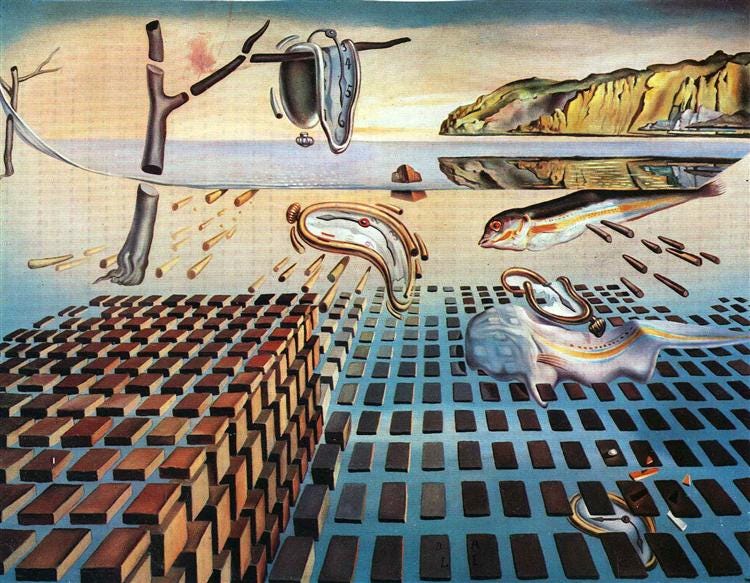
While on the topic of abstractions, we arrive at one of the most captivating things about this poem. For what could be more abstract and arbitrary than time itself? If the significance of machine tape is arbitrary, so is the way we measure a year. As the calendar turned, Ammons saw his daily ritual with the tape, his struggle with it, and the oncoming rush of January intersect. New Year’s Eve (or rather, the fact that the year turns) becomes one of the most fascinating elements in the poem despite Ammons treating it like any other day. No Aud Lang Syne, no Hail and Farewell— another day on the goddamn tape.
Yet— why name the poem Tape for the Turn of the Year and begin it on an ugly date like December 6th and end on January 10th if we’re supposed to focus on the moment of turning calendars? Is it just a matter of Ammons overestimating his ability to fill the tape in time and end it before saying “Happy New Year!” feels unnecessary? Or is this too part of Ammons’s meditation on the creative process? Perhaps all “processes” in general?
While Tape is not some rags-to-riches story about a poet who sucks and then learns to write, it is a poem about improvement— a goal that is frustratingly nonlinear.
Maybe you’re reading this on January 10th sixty years later, and you’ve already failed a goal you told yourself in the mirror with an angry point that it was going to be a daily, mandatory occurrence for you. Your morning pages, your daily crunches, your hour-of-no-screen-time-before-bed. New Years Eve is a time of endless promises where infinite, better selves are ripe for the picking. Aristotle once said that the most human activity is planning one’s life— it is what we do. Yet as the equally profound reaping//sewing tweet tells us, our fruits and our labor are directly linked.
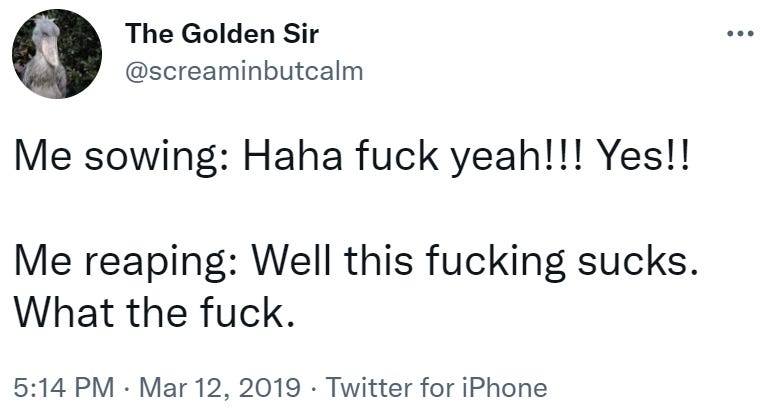
The winter is a time of low results. It’s the pain of crunches without shirts fitting any better. It’s feeling like you still got no sleep despite doing the routine exactly as you planned it. It’s feeling like you’ve said all there is to say in those first few days of morning pages and so you, like Ammons, start talking about the birds outside, and then maybe not at all. These first few days of January are a time of falling back into old habits, of giving up on the process you’d set for yourself. It’s all arbitrary, isn’t it?
with winter starting
at the bottom of the year
we can know
thru the cold of Jan & Feb
that the light is
lengthening,
the sun returning,
the planting of promises
like seeds:
that will break through
the plateglass ice,
stir the roots & bees:
spring, cleansed by winter:
We start at the bottom of the year just like Sisyphus at the bottom of the hill. Our task seems identical in ardor and hopelessness. Yet we are not hopeless, as Ammons reminds us that our sweat is not lost, our rocks are not fated to fall, and in fact we improve each time we lose control so long as we run back to retrieve the stone, echoing our thunder all the way down.
Mythologizing our pain, tracking time, romanticizing our lives— these aren’t coping mechanisms or needless abstractions so much as the radioactive “meaning” that glows on contact with our humanity. They’re the output and proof that meaning occurred. Whether we view it as toxic runoff, bile and the cost of doing tough business or the sweat worthy of immortalizing is, as all things are, arbitrary, and Ammons says it with a smile.
I feel a profound sense of despair whenever another car commercial (it’s always a car) deploys Robert Frost’s "The Road Not Taken” , a deeply sad and regretful poem, and use it to pedal ADVENTURE, suggesting that the road wasn’t taken because it didn’t have A MOTHERFUCKER OF A FOUR-WHEEL-DRIVE . Using art to pull yourself up is one of it’s most vital uses, but I take special exception to commercial use, especially when the interpretation of the poem is so wide of the mark.
I offer instead Tape for the Turn of The Year not as a call to adventure, exactly— but as a motivational shot in the arm. Perhaps it is the motivation you need, the proof that clumsy work is still work, and while your labor is not only never lost, it is mandatory
What started as an agonizing, painful, and fruitless project for Ammons found its profundity when the struggle to write the poem became the subject of the poem itself. By continuing to type when all seemed lost (or worse, foolish), he found the higher truth he looked unlikely to find and armfuls of beauty pooling in ribbons at his feet that he was never even looking for. He did this, largely, by making his own luck, sitting in a chair, and trying.
For those that feel stuck, that their 2024 self is a lot like last year’s model— know that the way forward is invisible to all of us. There is no one-path forward or inspirational bolt that will force everything into place. The only option is to flail helplessly and tap onto the tape. It is the only thing we know The Muse likes.
don’t ask me what you
should do:
if you decide to
sacrifice, you’ll have to
do the sacrificing: it’s
your business: figure
it out
for yourself:
if you don’t look out
for yourself, who else
has the time?
And if all else fails, there is a lot to be gained from a hard reset and turning the world around you into an abstraction, stripping them of our assumptions and assigning them new ones. Make the yoga mat sacred, the phone screen poison. Find your tape and don’t stop shaking it until the answers fall out.
why I selected
an adding-machine tape
was, I bet,
I thought things would
add-up on it
they don’t,
necessarily, I can tell
you:
must be a multiplying tape:
then I have defeated
abstraction
by multiple abstraction:
I knew I’d get you:
you bastard: